WaveGauge — 9 min read
The right river surfboard depends more on the wave you surf than your size or weight. This guide breaks down board volume, shape, construction (foamy vs hard), and how to match a board to your local wave.
Choosing a river surfboard can feel overwhelming — there are dozens of shapes, sizes, and constructions. But here's the most important thing to know up front:
> The wave you surf matters more than your size or weight when choosing a board.
River waves aren't all the same. Even if you took the exact same engineered design and dropped it into a different river, it would behave differently depending on what's happening upstream and downstream.
General rule of thumb:
For example, a 6ft, 200lb person can surf a Bomb Drop at Pueblo's Waterworks wave, but that same board won't work for them on the Staircase Wave in Buena Vista.
Foamy River Surfboards have a core similar to a hard board but are wrapped in a soft EVA foam deck with a slick bottom.
Why people love them:
Tradeoffs:
Hard River Surfboards use an EPS foam core wrapped in fiberglass and epoxy resin — the same construction used in ocean surfing for decades.
Advantages:
Tradeoffs:
Volume (measured in liters) is the key number in determining what board is right for you. More volume = more float = easier to catch waves on slower water. Less volume = more performance = harder to stay on in mushy waves.
| Board Type | Volume Range | Best For |
|---|---|---|
| High-performance shortboard | 25–35L | Fast, steep waves; experienced surfers |
| All-around river board | 38–51L | Most waves; intermediate surfers |
| High-volume / SUP hybrid | 80–104L | Slow waves, larger riders, beginners |
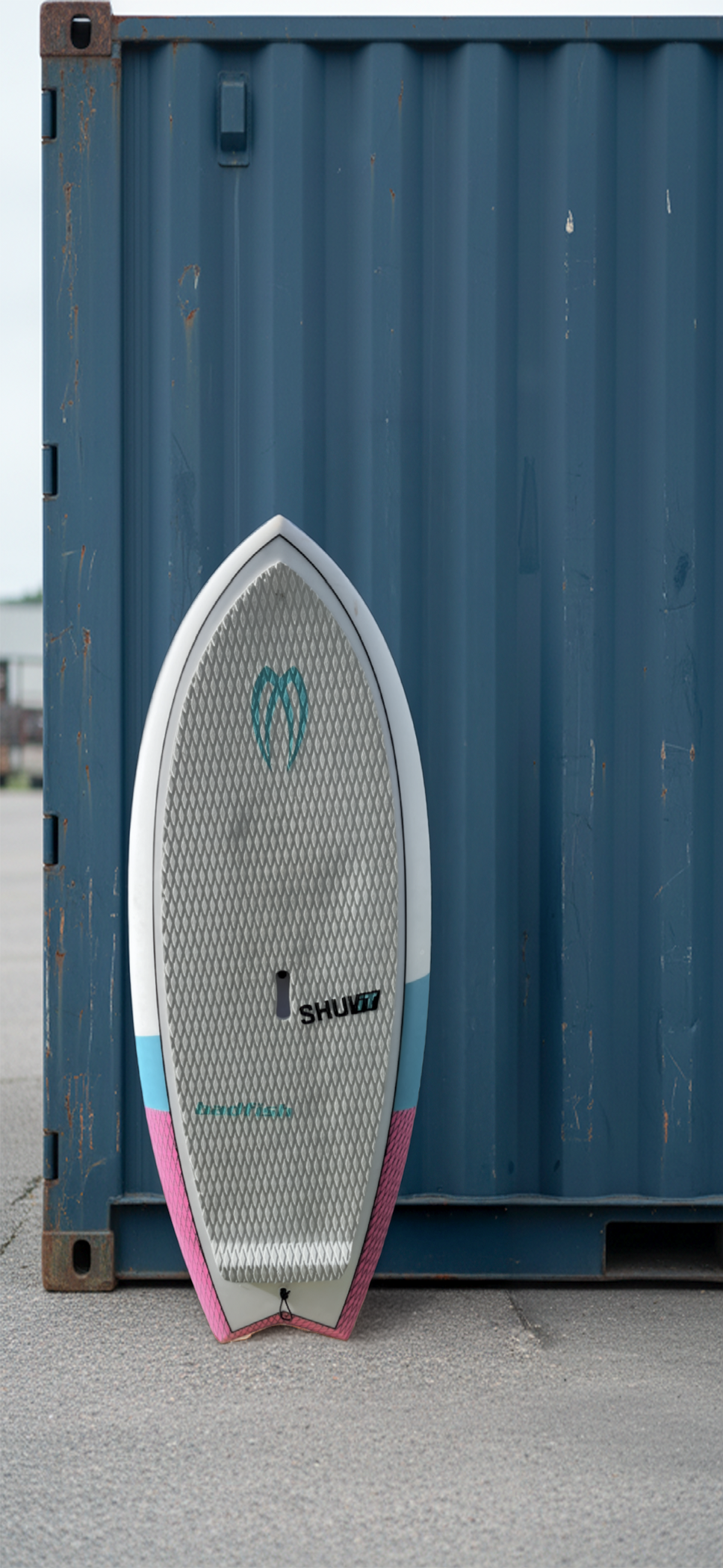
Fish shapes (like the Badfish Shuv-It, 5'2", 45L) — A fatter, wider board with a fish tail. Great for slower, mushy waves where you need lift. The fishtail lets you have a wider tail but still turn hard.
Shortboard shapes (like the Badfish Reverse, 5'9", 30L) — A high-performance board for high-performance waves. Less volume means it sinks more into the wave face for aggressive turns, but you need a fast, steep wave to keep it planing.
Hybrid shapes (like the Badfish SK8, 5'0"–5'6") — Combines volume with performance. The 5'0" SK8 has a unique drop rail that gives you thickness to float but thins out at the tail for edge responsiveness. The 5'6" SK8 is the longboard-and-shortboard package — all the volume you need for mushy conditions.
High-volume boards (like the Badfish 104 River Surfer) — The evolution of the original design that started Badfish. Meant as a SUP for river surfing, but many people use it as a shortboard because they want or need the volume. The single-wing fishtail means it turns well for a board of that size.
For fast, modern engineered waves (Scout, Boise, Bend, Tulsa, wave pools):
For slower, older park waves and natural waves:
For high-flow conditions when waves wash out:
The best beginner board isn't the cheapest board. It's the board that lets you catch waves consistently and build confidence.
A lot of people start by shopping price and end up on a board that doesn't match their wave. That usually leads to frustration. The right board doesn't just make surfing easier — it makes it fun. And that's what keeps people coming back.
As Badfish says: "At the end of the day, nothing beats that first wave where everything clicks." The right board can dramatically shorten the learning curve to get you there.
--- Sources: Badfish SUP, River Surf Lab