WaveGauge — 8 min read
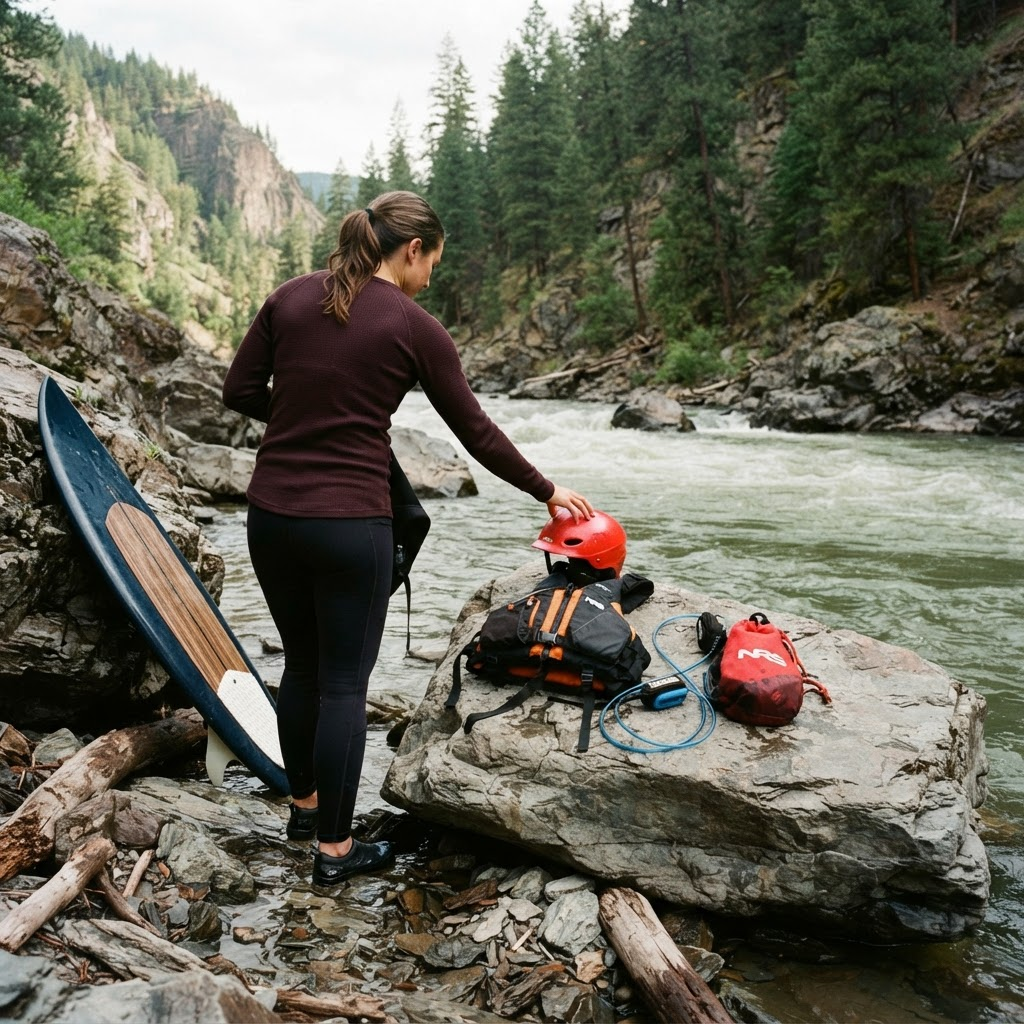
The river is not the ocean — it has unique hazards that require specific safety gear. This guide covers helmets, PFDs, quick-release leashes, and the critical safety rules every river surfer needs to know.
The river is not the ocean. It has unique hazards — submerged rocks, powerful currents, strainers, and foot entrapment risks — that require specific safety gear. This guide covers what you need and why each piece matters.
There are plenty of things to hit your head on at the river — rocks, boards, other surfers, bridge pilings. A whitewater-rated helmet is non-negotiable.
What to look for:
You're less buoyant in fresh water than in salt water. A PFD keeps you afloat if you're knocked unconscious, makes you easier to rescue, and gives you confidence in heavy water.
Why it matters:
What to look for: Low-profile, whitewater-rated PFDs that don't restrict paddling. The Astral YTV is a favorite among river surfers because it's slim enough for prone paddling but still provides real flotation.
> Finding a low-profile PFD for shortboard river surfing can be tricky, but you'll get used to paddling with one. The safety tradeoff is worth it.
This is the most critical piece of safety information in river surfing: NEVER use an ankle leash.
Every recorded river surfing death was due to an ankle leash. Here's why: if your board washes downstream and the leash catches on a rock, submerged log, or bridge pillar, the current pins you underwater with no way to release. An ankle leash cannot be reached when you're being dragged by the current.
If you use a leash, it must:
The Badfish Re-Leash is a 6' straight coil leash designed for river surfing. It connects to any PFD or the Badfish Surf Belt and releases with a quick pull.
When to use a leash vs. no leash:
Cold water is a safety issue, not just a comfort issue. Hypothermia can set in faster than you think, especially in mountain rivers that run in the 40s and 50s even in mid-summer.
Booties protect your feet from rocky riverbeds when you walk in and out.
A throw rope is a 50–75 ft floating rope in a bag that you throw to a swimmer in current. If you're surfing with a group, someone on shore should always have one. It's the single most effective rescue tool in whitewater.
Never stand up in the current. Standing up in the main current can cause a foot entrapment — your feet wedge between rocks and the current pushes you underwater. If the water is above your knees, the risk becomes life-threatening. Swim with your feet up until you can touch the riverbed with your hands while keeping your head above water.
Fall flat. River depth changes constantly. Always prepare for shallow water by falling flat — spread out to lessen your chances of hitting rocks.
Never surf alone. If it's your first time at a wave, don't go alone. There may be hazards that aren't visible from the bank. If there are no other surfers, wait until there are. Ask a local about hazards.
Look out for each other. On the river, we're a team. Always check that your fellow surfer made it out safely before hopping into the wave.
Observe before you surf. From the bank, watch other surfers. See how and where they enter the wave. Walk the swim-out along the bank — see where surfers get out and what's downstream in case you miss the take-out.
River surfing safety comes down to three things: protect your head, stay afloat, and never let the river hold you down. A helmet, PFD, and quick-release leash cover all three. The rest is common sense and local knowledge.
Be friendly out there, surfers. We're all in this for the same reasons.
--- Sources: Badfish SUP, Alberta River Surfing Association